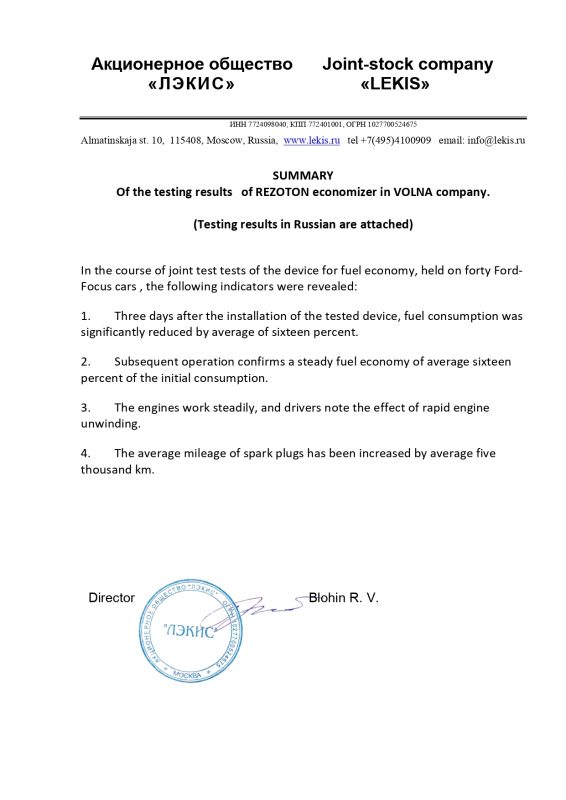
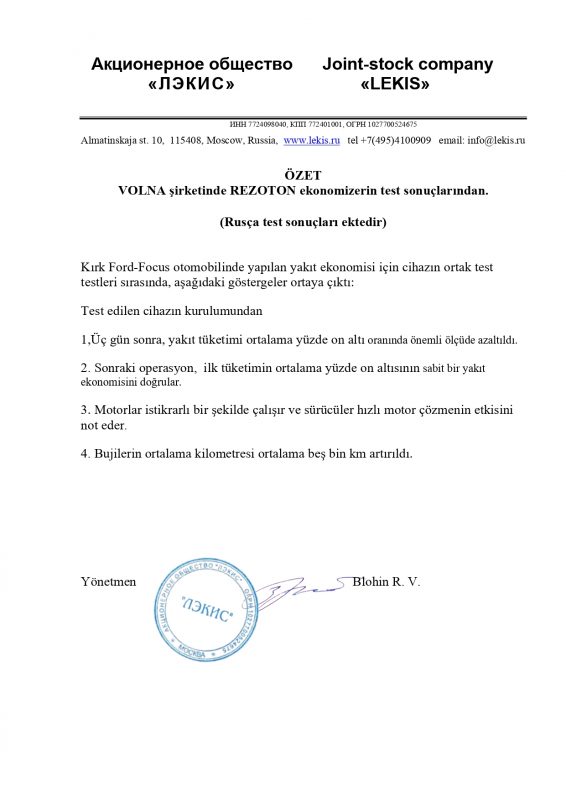
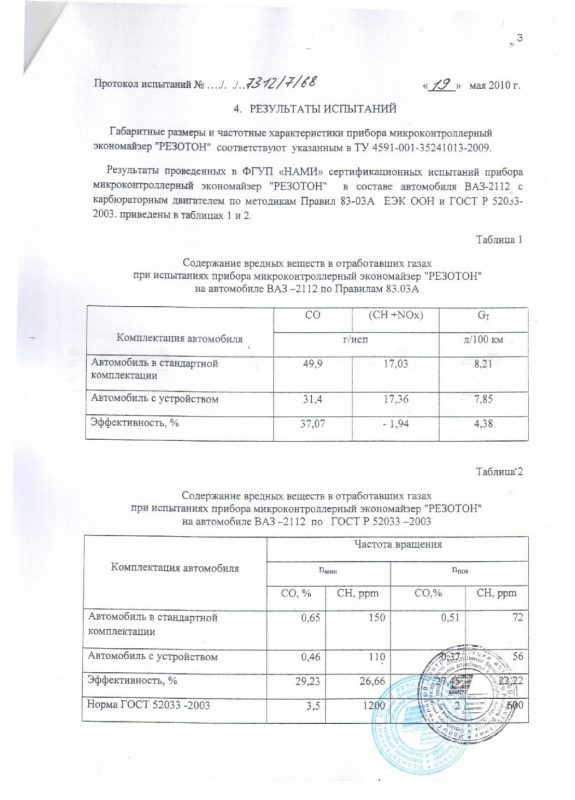
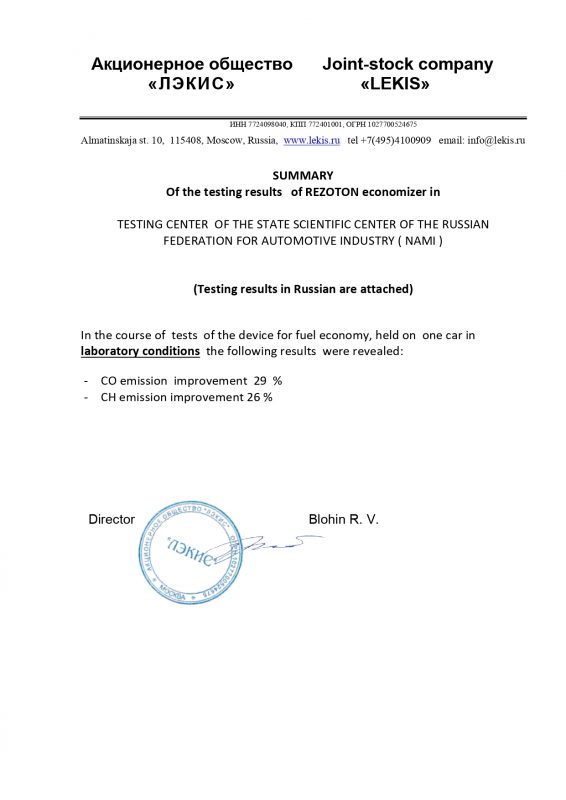
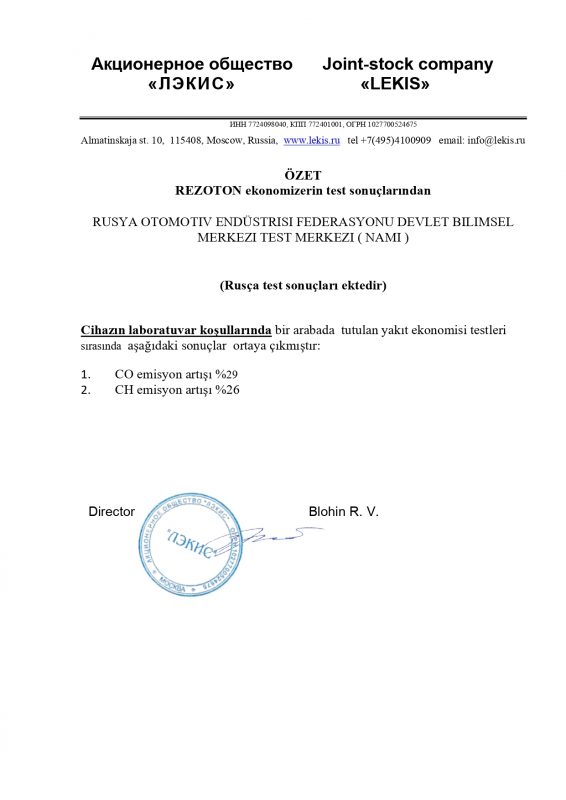
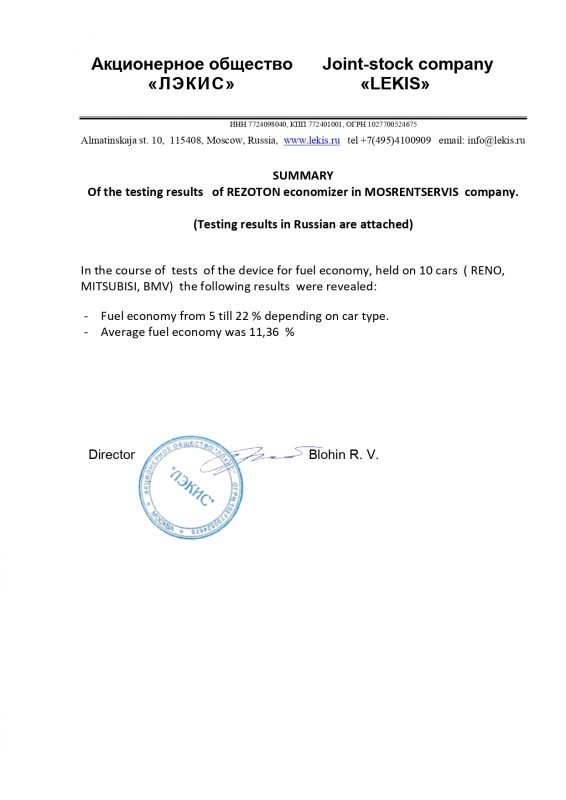
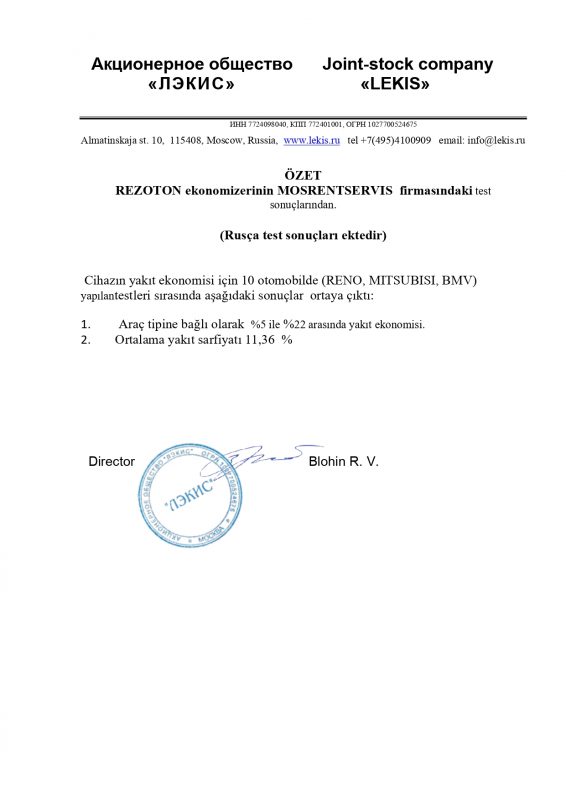
This test was done with the previous gas saving program,
but now was created much more advances new programs which in set of NEW SILVER STICKERS.
European cars of the RENAULT, AUDI, VOLKSWAGEN, VOLVO, MERCEDES, PEUGEOT, etc. brands
receive fuel savings from 12 to 30% . Cars of American brands, such as FORD and CHEVROLET from 15 to 20%.
Asian cars – Japanese, Chinese and Korean – from 5 to 12%. Russian brands of cars – cars and trucks – from 15 to 30%.
USB REZOTONE also have fuel saving program, but now we have more advanced programs in set of new SILVER STICKERS.
TESTIMONIALS about fuel saving program.
FINOLA, Ireland, January 2023
Definitely noticing a difference with the Gaz saving when the rezotone is plugged into the car, brought my nieces shopping before Christmas in Dublin which is 100 miles away and expected to have to refill on the way home and didn’t have to until 2 days later.
Very happy with the rezotone, it might be saving my life in lots of ways.
Amie, LA, USA, 21th of January 2020
“I currently have three of your USB devices. I love your USB REZOTONE keys. They even help with my gas mileage in my car by 4 mpg! I would like to buy three more from your website, so I can add a couple more in my house for 5g protection and one permanently in my car. My husband also keeps taking my other one to put into our car when we drive out of town. My gas mileage goes from 25 mpg to 29 mpg when we plug in the key to the car
NORM, UK
Hello Beautiful Julia,
I would like to also say that I am enjoying my fuel/gas savings in my car. I am truly grateful for the savings. Thank you to the Angels and All of You. You are greatly appreciated.
All the best, NORM, UK
.
Carol, Canada
I have been using this USB stick for a week now and I see a profound shift in the energy around me using phones, computer and so forth. I sleep better, have more clarity and it works really well in the car.
Nancy Collins, 81, Cape Cod, MA. USA
Definitely, my car is driving very smoothly, and my oil consumption is way up and is running fabulous !
A team from SWISS tested the gas stickers.
Their findings where that the plus/minus stickers gave an efficiency of 12%.
“Dear Julia,
We have a first valid test result on the R7 on an AUDI RS4 car, which came down from average 8,5 L/100 kg to 7,5 L/100 km. Which is 12 % !!! Just great. Many thanks and best regards, Team from SWISS”
Rezotone R7 was specially designed as a low cost long life device for fuel saving in passanger cars.
Our technology allows you to save more than 30 percent of fuel.
It does not require any alterations in the engines and the design of the installations. It is used both on petroleum and diesel engines.
DETAILED DESCRIPTION
R7 does not require external power supply.
Conforms to all European and US regulations.
Attaches to the wires going to the battery.
Consists of a set of two passive elements shown in the photo.
Each piece is the size of a credit card.
Can be installed by any person
Does not require maintenance.
Lifetime – 10 years.
Operating temperature range -60 +120 C
How can we easily and quickly measure the efficiency of our fuel-saving devices?
We need to do two experiments.
THE FIRST EXPERIMENT :-
Fill the car with fuel up to the throat of the fuel tank. You need to fill it so that the fuel starts to flow out of the tank. IMPORTANT : Most gas stations have a mechanism for shutting off the fuel fill when filling the tank. In this case, the shutdown does not occur at the maximum level. To fill the tank before the fuel leaks out of the tank – manually hold the gun handle in the ON state.
Another important issue in filling to maximum is that some tanks have a complex shape and air pockets. After filling to the maximum for a few minutes, observe whether the fuel level does not decrease. If it decreases, slowly add some extra fuel until the level remains stable for a few minutes. When pouring diesel fuel, pour especially slowly, letting the foam go away.
– After filling the tank, close the lid and drive any distance on any road at a FIXED CONSTANT speed. It is better if you have cruise control to fix the speed. To avoid speed changes, select a time when there are no traffic jams. Also choose a slightly lower speed than is usually used on this road. Turn on the emergency light so as not to annoy other drivers with your reduced speed. – We recommend driving a hundred or more kilometers. – Drive so as to return to the same gas station from where you started.- After returning to the gas station, fill the tank again to full level. – The amount that you fill in will be fuel consumption without our devices. This completes the first experiment.
– now you can install our fuel saving devices. INSTALLATION FEATURES: You need to attach one device to the cable coming from the negative terminal of the battery. The orientation of the attachment, the distance of the attachment point to the battery does not matter. Attach another device to the fuel tank close to the bottom of the tank. The range of our devices is about 40 centimeters. It should be attached to the bottom of the tank so that the devices can act on fuel even when there is not enough of it in the tank. If you have a tank of more than 80 centimeters in maximum size, then use several devices at some distance from each other. If you have an aluminum tank, then you need to use special devices for aluminum tanks. On such devices there is a letter A.
– After installing our devices, take photos of the installation location and send them to us for control. – Wait 48 hours after installation to fully activate our devices. – After 48 hours, check with our manager whether your car is ready to save fuel. If you are ready, proceed to the second experiment.
THE SECOND EXPERIMENT:-
Do everything exactly the same as in the first experiment. Refuel at the same gas station and on the same column. Drive on the same road and at the same speed. The mass of the car should also be the same as in the first experiment. Even the air temperature should be approximately the same. All these factors affect fuel consumption. Therefore, if you want to make an accurate experiment, then all the conditions of the first and second experiment must be the same. In particular, it is important that the car in both cases was equally warmed up at the beginning of the experiment. – After the end of the second experiment, compare the amount of fuel consumed in the first and second experiment. If in the first experiment you spent 6 liters, in the second experiment 4 liters, then the fuel economy thanks to our devices will be 30 percent. ATTENTION: after removing our devices, the car may consume less fuel for another month. So if you want to find out the effectiveness of our devices with different car loads, then first conduct experiments with different loads without our devices, then experiments with different loads with our devices.
FEATURES OF THE OPERATION OF OUR DEVICES.
For more efficient operation of our devices, we recommend refueling when there is more than 25 percent fuel in the tank. In this case, the old fuel will help our devices activate the new fuel faster. Such topping up will also help your fuel pump. Otherwise, if you drive before the light bulb lights up, then garbage from the bottom of the tank gets into the fuel pump and it fails faster.
IMPORTANT INFORMATION
Our devices do not change the property of the fuel instantly, but within a few hours. Therefore, in order to achieve maximum efficiency and maximum savings, we recommend refueling not when the tank is already empty, but when there is still about 25 percent of fuel left. The old fuel will mix with the new fuel and the new fuel will be structured faster.
ATTENTION
Our device creates micro-radiation, which is transmitted not only to fuel, but also to car parts. And these details themselves also begin to be a source of radiation. After removing the device from the car, the car parts continue to radiate and affect the fuel for about a month. Therefore, if you want to check the efficiency of our device, then first measure the flow rate without our device, and only then with our device.
If you do the opposite, then the car parts will continue to affect the fuel and you will get the wrong result. Therefore, ALWAYS measure first without our device, and then with our device.
What Technology Is Behind Fuel Economy?
The detailed operating principle of our fuel-saving technology is proprietary know-how.
Below we provide a simplified explanation using the passive R7 fuel-saving device as an example.
Active versions of the technology are based on the same fundamental principle, but include additional power-amplification components to extend the effective coverage area up to 30 meters.
How R7 Works
R7 operates as a contactless fuel-efficiency enhancement device.
The device does not come into direct contact with the fuel and does not require connection to the fuel line, ECU, injection system, or engine-control electronics. Instead, it works passively through a specially designed conductor-based structure installed on the vehicle.
The technology is intended to influence the physical and energetic state of the fuel system before combustion. As a result, the fuel-air mixture may burn more efficiently, allowing the engine to extract more useful energy from the same amount of fuel.
In practical terms, this may contribute to:
- more complete combustion;
- improved energy release during the combustion cycle;
- reduced fuel losses;
- lower fuel consumption;
- improved engine efficiency;
- potentially cleaner exhaust characteristics.
R7 does not add chemicals to the fuel, does not modify the engine, and does not interfere with the vehicle’s electronic control systems. Its advantage is the combination of simple installation, passive operation, and compatibility with both gasoline and diesel engines.
Scientific Background
The principle behind the technology is related to the broader scientific fields of Some modern studies show that catalytic and energy-transfer effects may occur under conditions where direct chemical contact is not the only mechanism involved. Research in non-contact catalysis, for example, demonstrates that catalytic activity can be initiated or influenced without the conventional direct interaction model.
In a broader scientific context, the development of quantum information science has also expanded the understanding of how information and physical states may be transferred, correlated, and influenced at fundamental levels. One of the key pioneers in this field, Anton Zeilinger, was awarded the Nobel Prize in Physics in 2022 for experimental work with entangled photons and quantum information phenomena.
These scientific directions do not disclose the proprietary mechanism of R7, but they illustrate the wider research context in which non-contact and information-based physical interactions are being studied.
References
R. A. Sheldon, J. K. Kochi.
Metal-Catalyzed Oxidations of Organic Compounds.
Academic Press, 1981.
Anyang Peng et al.
Noncontact Catalysis: Initiation of Selective Ethylbenzene Oxidation by Au Cluster-Facilitated Cyclooctene Epoxidation.
Science Advances, 6, eaax6637, 2020.
DOI: 10.1126/sciadv.aax6637
D. Bouwmeester, A. K. Ekert, A. Zeilinger.
The Physics of Quantum Information.
Springer, 2000.
Simple Result
R7 is designed to help fuel burn more efficiently — without chemicals, without engine modification, and without active electronic intervention.
A passive device. A simple installation. A measurable fuel-saving effect.
________________
Installation Principles and Physical Interaction
The operating effect of the R7 fuel-saving device may vary depending on the installation point.
For optimal performance, we recommend installing the device in two key locations:
- on the battery wire;
- on the outside of the fuel tank.
Each installation point supports the fuel-efficiency effect in a slightly different way.
1. Installation on the Battery Wire
When electric current passes through the wires connected to the vehicle battery, an electromagnetic field is naturally formed around these wires. In the schematic illustration, this field is marked as A.
The specially designed material structure of the R7 device interacts with this existing field and passively re-radiates it at selected frequencies. These frequencies are chosen to be relevant to the fuel system and combustion process. In the schematic illustration, the re-radiated field is marked as B.
The arrows in the illustration are used only for simplified visual explanation. They should not be interpreted as exact force-field lines or as a precise physical diagram.
Through this resonant interaction, the re-radiated field may influence the physical state of the fuel before combustion. As a result, the fuel-air mixture can burn more completely and release useful energy more efficiently during the combustion cycle.
This may allow the engine to perform the same amount of mechanical work while consuming less fuel. In practical terms, this is observed as fuel savings.
The re-radiated field generated by the device is extremely weak and is thousands of times lower than the electromagnetic field level produced by a typical mobile phone. R7 does not interfere with the vehicle’s electronic systems, does not affect the driver, and does not create active electromagnetic emissions.
The effect is achieved passively due to the specially selected resonant properties of the device.
2. Installation on the Outside of the Fuel Tank
R7 may also be installed on the outside of the fuel tank.
In this position, the device uses the vehicle’s existing electromagnetic environment and can operate together with the device installed on the battery wire. When both installation points are used, the devices may support and enhance the overall fuel-efficiency effect.
The fuel-tank installation can also work separately as an independent passive application.
Due to physical limitations of passive field interaction, the effective influence distance of the device near the fuel tank is approximately 40 centimeters. For larger tanks, we recommend installing several R7 devices to provide better coverage.
For very large tanks, industrial applications, or extended coverage requirements, we recommend using active versions of the technology with power-amplification modules.
R7 can be installed on fuel tanks made of different materials, including:
- plastic;
- steel;
- aluminum;
- other common fuel-tank materials.
The device does not need to be placed inside the tank and does not come into direct contact with the fuel. Installation remains external, simple, and non-invasive.
Recommended Configuration
For best results, we recommend using R7 in a combined installation:
one device on the battery wire + one or more devices on the outside of the fuel tank, depending on tank size and vehicle type.
This configuration allows the technology to interact with the fuel system from two complementary points, supporting more efficient combustion while keeping the installation simple, passive, and compatible with both gasoline and diesel engines.
Simple installation. Passive operation. More efficient fuel use.
Fuel-Saving Technology for Engines and Power Systems
Our technology is designed to reduce fuel consumption in internal combustion engines and combustion-based energy systems.
In tested applications, our devices have demonstrated fuel savings from 9% to 30% in internal combustion engines. The technology does not require engine modification, does not require changes to the fuel supply system, and can be installed externally.
It can be used on a wide range of applications, including:
- vessels;
- diesel locomotives;
- aircraft and aviation systems;
- trucks;
- passenger cars;
- diesel generators;
- power-generation systems;
- industrial combustion equipment.
The technology is suitable for engines of different sizes and can be applied wherever hydrocarbon fuels are burned, including diesel fuel, gasoline, kerosene, aviation fuel, marine fuel, and gas.
We are also studying potential applications in coal combustion. Additional experiments in this area are planned.
Operating Principle
The detailed operating principle of our fuel-saving technology is proprietary know-how.
In simplified terms, fuel savings are achieved through non-contact fuel structuring by a weak resonant field. The device does not need to be placed inside the fuel and does not add any chemical substances.
The effect is based on a passive interaction with the fuel system. As a result, the physical state of the fuel may be influenced before combustion, helping the fuel-air mixture burn more completely and release useful energy more efficiently.
This can lead to:
- more complete combustion;
- improved energy release during the combustion cycle;
- reduced fuel losses;
- lower fuel consumption;
- potentially reduced emissions.
The operating principle is described in more detail here.
An additional benefit of more efficient combustion is the potential reduction of harmful emissions into the atmosphere.
How We Differ from Competitors
The key difference between our technology and many competing fuel-saving solutions is the method of application.
Our device is installed externally and does not require any changes to the fuel supply system, engine, injection system, ECU, or onboard electronics.
This creates several important advantages:
- no chemical additives are added to the fuel;
- no mechanical parts are inserted into the fuel line;
- no changes are made to the engine;
- no interference with the manufacturer’s engine design;
- simple installation;
- lower risk for the vehicle owner or fleet operator.
Many competing solutions are based on fuel additives or mechanical devices installed directly into the fuel supply system. In both cases, the user may face additional risks related to engine compatibility, fuel-system reliability, maintenance, and manufacturer warranty conditions.
Our approach is different: external installation, passive operation, and no invasive modification of the engine.
Testing Results
We continue to test and improve our technology in different engines, fuels, and operating conditions.
1. Road testing results on cars and trucks can be found here.
2. We also tested the change in total gross heat value of gasoline after treatment by our catalyst. The measured increase was approximately 2%. Results here.
This indicates that the fuel-saving effect may come from two complementary directions:
- more complete combustion;
- an increase in the useful energy released from the fuel.
3. A test on a gasoline engine was conducted on a test bed. The result showed fuel savings from 9% to 21%, depending on load and rotation parameters. The results of the test are found here
4. A separate test on a HONDA L13A4 gasoline engine on a test bed showed fuel savings from 9% to 17%. Detailed report here
5. The first samples of our catalysts were created approximately 15 years ago and are still operating without a reduction in efficiency. This demonstrates the durability of our devices and the long-term stability of the technology.
Safety and Fuel Compatibility
The first fuel catalyst was produced in our laboratory approximately 15 years ago. During this period, we have not recorded operational problems caused by the use of our catalysts.
Our laboratory tests show that fuels treated by our catalyst continue to comply with the technical parameters and standards required by applicable fuel regulations.
This means that fuel treated by our catalyst can be used in engines without requiring special additives, chemical changes, or additional approval from engine manufacturers.
Buyers and partners are welcome to conduct their own independent tests of fuel after treatment by our catalysts in order to obtain local confirmation of fuel quality and compatibility.
We can supply free samples of our catalyst for such testing.
Limitations of the Technology
The changed physical state of the fuel is maintained only for a limited period of time. For this reason, the fuel should be treated close to the point of use — for example, in the fuel tank — rather than at the refinery.
There are also certain technical situations where the fuel-saving effect may be lower.
So far, we have identified two main cases.
Engines Without Intelligent Fuel Supply Control
The technology works best when the engine has a sufficiently advanced fuel supply or engine-management system.
In simple diesel power generators without Common Rail or an equivalent adaptive fuel-management system, the device may improve the fuel, but the fuel supply system may not automatically reduce the amount of fuel delivered to the engine.
In such cases, the fuel may burn better, but the engine may continue injecting the same amount of fuel. As a result, the fuel-saving effect can be limited.
For this reason, modern engines with more advanced fuel-management systems usually show better results than older engines.
For example, we measured approximately 11% fuel savings in a Toyota Corolla produced in 1996, while a Ford Puma produced in 2023 showed approximately 30% fuel savings.
Patents and Know-How Protection
Our technology is protected primarily as proprietary know-how.
The core value of the technology lies in the accumulated research, production methods, material configuration, and practical experience that cannot be reproduced by external appearance alone.
For this reason, we are able to provide samples of our catalysts for testing even without signing non-disclosure agreements.
The visible form of the device can be copied, but the functional technology behind it cannot be replicated without the underlying know-how.The passive modification R7 does not require external power.
It is simple to install and usually takes only a few minutes.
Potential Savings
The economic benefit of our technology can be demonstrated using a simple example from the truck industry.

Assumptions:
- vehicle: truck with an average diesel engine;
- fuel consumption: 30 liters per 100 km;
- monthly mileage: 10,000 km;
- annual mileage: 120,000 km;
- fuel cost: $1 per liter;
- annual fuel consumption: 36,000 liters;
- annual fuel cost: $36,000.
The average savings from the use of our devices can reach approximately 20% depending on vehicle type, fuel, engine condition, route, load, and operating conditions.
For a conservative calculation, let us use only 10% savings.
In this case:
- annual fuel savings: $3,600;
- device lifetime: up to 10 years;
- total potential lifetime savings: $36,000.
In real operating conditions, fuel prices may be higher, and large fleets may achieve significantly larger total savings.
Beware of Copies
Our technology is protected by proprietary know-how and cannot be reproduced by external appearance alone.
A copied product may look similar from the outside, but it will not contain the functional technology required to achieve the fuel-saving effect.
Please report any suspected copies or unauthorized imitations to our team.